Although by now we should have been seasoned professionals at crossing borders in Central America, they still filled me with apprehension. It wasn’t the thought of the unknown that made me hate border crossings; that was the most exciting thing about entering a new country. It was more the fact that wherever there was a border, indeed, wherever there was a tourist, there was also a rip-off merchant lurking in the shadows.
It was inevitable that these two things went together. They seemed to always come out and try to hit you when you’re at your most vulnerable, when you don’t know where you’re going or what the currency is worth. Running so dangerously low on money at this stage, in one sense, we had less to lose but, because of that, every time we did lose anything, or over-pay for something, its loss was felt more sorely. And with our backpacks appreciating in emotional value every day from all the souvenirs we had picked up, I became less and less willing to hand them over to the bus workers and watch them disappear from sight onto the roof above.
After yet another morning of me having to play “alarm clock Nazi” and Tony doing his usual “shifting-into-reverse-gear-mode”, I eventually managed to hustle us out of the hotel. A little late, but in time to make the walk to Mi Esperanza bus depot (or so we thought). After last night’s torrential downpour, which caused a power-out (and some of the most violent thunder I had ever heard) the morning was far from cool, even at 8.30: in fact it was sweltering hot. The walk to the station was not ‘cuatro cuadras’ as we had been told, but more like fifteen.
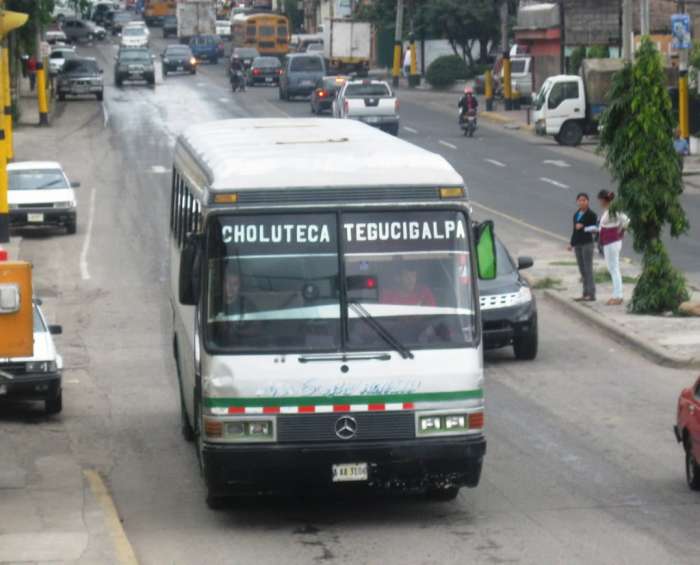
We hurried along the dusty, busy streets, descending further and further into the worst district of town in the Capital of one of Central America’s most dangerous countries. With the weight on our backs, we sweated and were told “si, recto, recto, recto!” every time we asked for directions, assuring us that we were on the right track, even though we appeared to be getting nowhere. After at least 20 minutes of walking (and several near-death experiences attempting to cross the hectic streets), we eventually saw a bus swinging around the corner, bound for Choluteca.
“That’s the bus!!” I closed my eyes and let out a howl “it must have already left.” Fearing an hour of waiting on the pot-holed sidewalk by a taco stand, being stared at by passing alcoholics and crackheads, I started to whimper. Tony took the initiative and started frantically waving his arms in the air. The bus pulled over on the other side and we (rather recklessly) managed to navigate our way across the street, darting in and out of cars.
“Es para Choluteca?” I panted at the bus driver. “si, si, si” he yelled back, and we bundled ourselves on to the bus. It’s hard to describe the sense of relief that washes over you every time you succeed in securing yourself a seat on a bus or finding a place to stay after hours of travelling in a foreign country. It’s something like the few seconds after awaking from a nightmare, where you realize that it was just a dream, and that you don’t actually have two heads after all. When that backpack is lifted from your shoulders and plonked down on the seat in front of you, a mental weight as well as the physical one is lifted from your shoulders. I sat back in my seat and panted. Tony winked at me “alright babe, we made it.”
The bus began to make its way painfully slowly along the same road we had just struggled down, as it stopped every few minutes to let people off. I didn’t notice any thing out of the ordinary about this, until Tony asked “why are people getting off?”
“what do you mean, why are people getting off? It’s a bus. It stops”
“No, but it’s going to Choulteca, so people wouldn’t be getting out here in Tegus, would they?”
It was then that we realized that the bus was actually coming from Choluteca, and we had to endure a tedious loop through Comayaguela’s frantic back streets and markets, before changing buses at Mi Espiranza’s other depot, about four blocks away from our hotel. Beyond the initial irritation about having to walk unnecessarily along the bad streets with our luggage, as long as we were safe, the only real nuisance about this unexpected scenic tour, was the hour that we lost in time. It was to be the blue print for the rest of the day.
We prepared ourselves for the three hour journey to Choluteca which (although closer to three and a half), passed without any major incident, and involved the usual vendors leaping on every time we stopped, selling anything from flash lights to clothes to Coca Cola and full blown comidas.
I noted with interest the subtle changes in culture from country to country, down to the very simple things, such as the way they speak, or the food they eat. A taco in Mexico is soft and small, an enchilada, similar to a taco, but a bit longer and a quesadilla usually just plain cheese sandwiched in between 2 tortillas (although, if they were feeling creative, it could involve an assortment of ingredients, such as onions, peppers, and meat).
In Honduras it’s not the same. An enchilada is what a tostada is in Mexico (a crispy shell topped with meat and cheese). A taco is larger and baked, giving it a crunchy texture, the quesadillas they were selling on this particular bus were another thing entirely. Strange cookie-like objects that caused the jaw to ache after several bites, laced with a sweet, syrupy gel. I think they’re the kind of thing you would get used to and eventually even like if you spent any length of time in Honduras. I couldn’t quite claimed to have reached that point yet. But seeing as these appeared to be the only snack on offer, and with both of our stomachs rumbling, we decided to part with a couple of limpiras, and put up with an aching jaw.
We arrived at Choluteca, and boarded a microbus for Guasale, the border town to Nicaragua. Although our luggage was on the roof, and the spitting rain drops and black clouds threatened to drown our packs, we luckily made it to the boarder with dry luggage. As the bus pulled into Guasale and I climbed out, I was encircled by at least six men with bicycle taxis and dollars and cordobas, all pulling and harassing me into changing money with them and choosing their vehicle to take us to the frontera.
After about five hours of travelling, it was utterly over-whelming and I had to grab my backpack from the clutches of more than one over-eager bicycle men. I changed some money and waited for Tony to get out of the bus. Five minutes of chaos ensued, as they yelled their prices at us and tried to explain why their’s was the best way to get to the border. I had to keep pleading “uno momento, uno momento” and stepping back while I caught my breath.
After the ripping off incident at the Mexico/Guatemala boarder, I was determined not to be had again. Eventually, we chose one guy to take us there for 10 cordobas, and I foolishly tipped him one US dollar (which more than doubled his original price). But with four countries and four currencies inside of a week, I was perhaps understandably a little confused- in fact, my brain was fried.
Anyway, we were at immigration. Feeling pleased and surprised that we were not charged on exiting Honduras, our spirits fell when we discovered we had to pay UD$7 to get into Nicaragua. And they only accept US dollars, which, considering how many miles away we were from the United States, seemed quite bizarre to me. Anyhow, that’s the way it was and we were forced to change seven dollars worth of cordobas back into dollars (having just changed them moments before) and Tony lined up in the bank while I chatted to the security guard in my best broken Spanish.
If I thought Honduran Spanish was a little hard on the ear, then Nicaraguan Spanish is even more so. They meow when they speak and miss the ends off of words, which is terribly confusing with prices and numbers (something we had tried so painstakingly to learn).
A few stamps later, a few dollars poorer and another sweaty walk to the bus station, we were bundled on to another bus. This was a “Leon express” bus which only cost 15 cordobas and would omit having to change autobuses and Chinandega.
With our backpacks safely behind us on the bus (infinitely more comforting than strapped onto the roof and out of sight) and both seated, we awaited the departure of the bus. We sat and waited. And waited. And waited. As the sun streaked through the windows and the bus became more crowded, I had the sensation of being a fly trapped in a jam jar. I also needed the toilet. But it would only be another 2 hours to Leon when we eventually got going. I could wait. I looked out of the window at the dusty, dirty area where buses congregated and under-fed horses and over-fed pigs mingled about with the people. Our sixth new country.
During the wait (of not far short of an hour) we were at least kept entertained by the chaos around us. I was awe-struck by the number of fat people (most notably women) with huge behinds, in this poor country where much of the population could scarcely afford to feed themselves.
As they attempted to squash past each other up and down the bus, on more than one occasion did two huge asses become tightly wedged in between two seats in the narrow corridor of the bus. And then a very large lady, with an even larger basket on her head hauled herself into the bus with all the effort of a man attempting to pull an over-size truck up a hill.
Her purpose, and therefore the purpose of her basket was explained a few moments later when she produced a pile of tortillas and began to slaver them with sour crème and onions, rolling them up into plastic bags and handing them around the bus. I have to say, they would have been slightly better had they been a little warm, but, not having much in my stomach, it was not an unwelcome snack. And still the damn bus stood stationary.
Being left with a plastic bag of sour crème and onions on my lap, I was faced with a predicament. Of having it soak through onto my lap, or following the example of our fellow passengers and tossing it out of the window. Being, at some times, almost anal in my disposal of litter, it was a hard choice to make. I took a deep breath, closed my eyes and let it drop down the side of the bus into the seething pile of pig shit below. “I’m really sorry” I thought. I wasn’t sure exactly to whom.
The engine spluttered into life at last and within a few moments, we were finally on our way. We had scarcely covered two or three kilometers when we encountered a policia road block and the bus was forced to come to a grinding halt. Pandemonium reigned, as armed police jumped onto the bus, checking for goods and forcing people off.
Apparently, the bus was laden to the gills with goods brought in from Honduras. Goods for which the owners had evaded paying the duty on. We wondered what they could be checking for at first- drugs? Weapons? Counterfeit money? I stared up at the “PELIGROSO” skull and cross bones pesticides around us and at the bag of the lady with the sweaty, hairy, fat armpits beside which was chocked full of tablets, and decided this must be what they were after.
But after they ushered more passengers off of the bus and found more of what they were looking for, I realized it was more cans of pop and boxes of chips. The pesticides and dubious-looking tablets were not even afforded a second glance. These are such strange countries.
After nearly an hour, a slightly lighter bus and most of the passengers reboarded, we again attempted to set off for Leon (the police apparently satisfied). I breathed a sigh of relief until we were flagged over again after scarcely pulling away. The policia waved at the driver to stop and the whole of the bus started yelling at the driver to carry on and ignore the police.
He nearly did until out of no where another police car appeared. Bigger police with bigger guns (AK47s) boarded the bus. Confiscationg more boxes, ordering more passengers off. We sat and watched as the people started playing games with the police. Waiting until they were on the bus, to throw themselves over our seat and fling bags and boxes out of the window at their friends. The woman with the sweaty arm pits kicked her bin liner of prescription drugs under our seat. Surrupticiously, Tony pushed them under the seat of the fat arsed lady in front.
After a couple of hours of delay (the time was now a quarter to five) the bus was ordered to return to the border. With admirable speed and strength, we managed to haul our backpacks out of the seat and squish past the obstacles in the path of the exit (one of which included and armed policeman) and jump out of the moving bus.
“FUCK!!!!!!!!!” we both resounded. Our skin was sticky and wet and I could feel sweat beads coursing down my stomach. There was now no way we would make it to Leon before dark and I had lost count of the amount of times we had promised each other not to arrive in a strange city after dark again.
Standing on the side of the Nicaraguan highway, with our packs at our feet and rain clouds beginning to form, I felt suddenly a long, long way from home. And still I needed the toilet.
We hadn’t been waiting too long however, when a bus for Chinandega rumbled along the dirt road and we were able to squeeze ourselves onto it, with our packs hauled on to the roof. As I melted into the seat, whacked out from heat exhaustion and frustration, I made a little mental deal with God. He was allowed to let the rain saturate our baggage, as long as it was still there when we reached our destination. The rain drops fell. He at least was keeping his part of the bargain.
Ten minutes into the journey and we encountered our third police road block. Absolutely everything, it seemed, was conspiring to keep us from reaching Leon. At least this bus was relatively empty of goods and we only had to wait for a few minutes while objects (probably including our backpacks) were hauled off of the roof and checked. We were on our way again.
Sharp pains were beginning to form in my stomach from holding my pee too long. It had been hours and it was to be at least another two before I found a bathroom. I am sure that my expression on that bus must have been one of absolute misery as we bumped and swerved our way along the pot-holed, unpaved road, every movement jiggling my bladder.
The sun set dramatically over the volcano, painting the sky with vibrant pinks, reds and oranges. I would have thought it devastatingly beautiful, had not it’s presence indicated the imminent darkness. Many bumps, swerves and stops later (and at one point a dangerous over-take which saw us sandwiched in between two huge lorries) and we finally rolled into Chinandega. Our luggage was there- and it was covered too.
I left it with Tony and went off in search of a bathroom, in a nearby cantina. I took a deep breath and walked in. My entrance was greeted with silent stares of pairs of dark eyes belonging to men with too much drink inside of them. I walked up to the bar and asked for a baño. I was pointed through some beaded curtains.
I walked straight into a large room of pool tables, gambling, and horny men. A gringa in the midst of a huge, men only cantina. I pulled at the dilapidated door of the baño and was greeted by a man sitting down taking a shit. I immediately slammed the door.
Suddenly a plump and kindly old lady arose out of the hammock she had been occupying and came to my side. She was gentle and grandmotherly and spoke to me in broken English, most of which I couldn’t understand, about her family in Texas.
She banged on the cubicle door at minute intervals, yelling at the man in Spanish to come out. He grunted back momentarily in reply. She vanished. I was left with fifty pairs of eyes boring into me.
She re-appeared with a roll of toilet paper and a smile, then turned back to the door of the toilet and proceeded banging again with great force. Eventually, the man came out and grunted something under his breath. The lady went in and before she would let me enter, she grabbed a bucket of water and poured it into the bowl. “It’s OK now”. She handed me the paper. I closed the door and relief flushed over me as the liquid flowed from my body and my stomach pains began to subside.
As I went to leave, I walked over to the lady and thanked her. She gave me a hug and wished me safe and happy travels. I felt like crying at this point. Her kindness overwhelmed me. As I emerged from the cantina, I found Tony speaking in English with some Nicaraguan guys outside. They were so friendly and so cool and pointed us in the direction of the micro bus to Leon. We thanked them and walked off towards the bus, and as we did so, one of the men ran up behind us and pointing again as to where we should go. These people were so friendly and so kind, and I couldn’t believe that we could have found such shining lights in a day such as this.
Forty-five minutes in a microbus, one taxi ride, and a short walk later, we finally reached Casa Ivana, our sanctuary in the dark streets of Leon. Twelve hours to complete a four hour journey. I lay on the bed and closed my eyes. Against all the conspiring odds, police blocks, boarder crossings and potholes, we had made it through one of the most testing days of our trip.



 Gypsy Spirit