Nothing Will Ever Be the Same – Nicoya Earthquake, Costa Rica, September 5, 2012

Once you know that the earth can move and buildings can sway in the wind like leaves in the breeze, it’s like nothing you ever knew to be true really is anymore, or will ever look the same again…

The Break of Dawn

The day of the quake dawned much like any other – a little early for my liking. I pulled back the curtains, heavy eyes squinting in the morning light. The sun was already shining on the swimming pool, shimmering on the clear blue water, and the birds were chattering noisily in the trees above. A lazy iguana was stretched out below; reveling in the potent rays and the monkeys began to howl from deep within the jungle.

I closed my eyes and inhaled deeply, almost feeling the air, lightly scented with Hibiscus, breathing life into me. It was a morning ritual I had gotten so used to and yet, somehow, could still barely believe was real. This time last year I stared bleakly ahead at the mildewed walls of my dingy, windowless, ground-floor apartment, the perpetual drilling of the round-the-clock construction site grating at my fraying nerves.

No matter how tired I feel today, or the fact that I would rather be splashing around in the surf or lazing a little longer under the comforting covers of my king-sized bed, I smile at my moment of peace and the morning sun that dances on the water just for me.

If I had known that would be the last time I would look out of my balcony while the world was asleep at the glorious morning below, perhaps I would have dwelled there a moment longer, memorizing the intricate details of life from this vantage point that I would never see again.

But I’d overslept and dragging myself out of bed with ten minutes to spare doesn’t even give me the chance to shower, let alone marvel in the wonder of Mother Nature, before I start my working day. I just about manage to splash some cold water on my face and grab a garment from the closet before I hear the swishing sound of Skype as my computer cranks into life.

I throw on my tired, old, fading, floral green dress and scoop my unkempt, sun-bleached hair into an untidy ponytail. I don’t even look in the mirror; my eyes aren’t really open yet and I’ve never liked this dress – I have no desire to see how it hangs unbecomingly on my frame. It has now been officially relegated to wear purely inside the house, upon being informed that I have actually been recognized about town on more than one occasion because of its distinctive pattern.

My original six weeks in Costa Rica have accidentally extended into an undefined period and my wardrobe is failing to keep pace. I’m so bored of my clothes and I have absolutely no use for the thick sweaters and figure-hugging jeans I packed for winter in Buenos Aires. I don’t even bother to scan the room for underwear today, knowing that the clothes I washed yesterday have been forgotten in the machine since last night.

I still marvel every chance that I get at this crazy ride we all call life – its twists and turns, highs and lows. Not so long ago I painted my nails every evening before going bed and applied lipstick and mascara every morning, after blow-drying my hair and going over my lines. I squeezed my tired feet into tight three-inch heels, a suit jacket hugging my waist with the suggestion of cleavage below. I knew full well that a meeting would always go better if they fell in love with me just a little.

Now I don’t even shower before work. I’ve learned from this new timetable of mine that I am not really a morning person. My memory is thick and foggy and my reflexes are weak. I am exceptionally accident-prone. In the last couple of months, I’ve sliced open my foot from a falling bottle of Tabasco that bounced off the kitchen worktop and doused my scalp in 40% DEET bug spray before 6am. Needless to say, I no longer bother with even the most menial tasks first thing in the morning. I’m too scared to put on the coffeemaker for fear of burning the house down or breaking something more important than a toe.

Instead I sit at my desk and sift through the stack of emails that need to be written, problems that have to be solved, and ideas waiting to be nurtured. After an hour and a half of my blurry eyes on the screen I decide it’s time to get me a coffee. It’s safe now; my morning stupor has passed and I successfully load the coffeemaker, yawning as I wait for the precious black liquid to drip down into the jug. I just about have time to run up the mountain of stairs to the top floor and set down my coffee cup as a deep, unearthly groan begins to rumble from below and the ground starts to move beneath my feet.

In the Eye of the Storm

With the first shake, I don’t immediately register the magnitude of what is happening. The desk starts to jump up and down and I leap out of my chair to see the solid oak bed ricocheting towards me. The building is shuddering uncontrollably and, as I throw myself under my desk, pieces of ceiling start to fall.

The house is convulsing violently. I cover my ears at the horrifying smashing of breaking glass and the terrifying moaning of the land. In a fleeting second, I realize that this isn’t just another of those quirks and bumps and oddities that make up life in Central America – like cattle in the road or a monkey on the phone line – we’re having an earthquake and it’s totally out of my control. Oh my God, we’re having an earthquake and I have absolutely no idea what to do.

I flinch as the chair legs scrape sickeningly across the ceramic tiles and the desk I’m crouched underneath jolts up and down with increasing vigour. The coffee cup I had been drinking out of moments before and the microphone I’d been speaking into crash to the floor beside me. The wardrobe bursts open and I watch as my clothes and jewellery and make-up are shaken off of the shelves and the doors swing open and shut.

I keep waiting for it to end but the angry earth unleashes more of its fury and the jagged convulsions grow stronger. My heart is thumping so hard in my chest I can feel it banging against my ribcage and beating deafeningly in my ears. I think I’m crying but I can’t be sure – between the ceaseless pounding of my heart and the inability of my brain to process what’s going on around me, everything blurs into confusion.

The building and its contents have suddenly come to life like something out of Alice in Wonderland and I feel like I’m in the waking moments of a dream; unable to distinguish fact from fiction. Maybe this day never really started at all and I’m still somewhere in the limbo between sleeping and waking; the dying embers of the night and the bright light of morning.

The next few moments play out in slow motion, as my mind captures every terrifying microsecond, like the shutter of a camera, frame after frame. Smash… the mirror shatters into a thousand pieces, thud… my book of Italian verbs falls to the ground, slam… the wardrobe door closes again, thump… my panicked heart beats in my ears. I watch incredulously as everything that’s supposed to be solid and stable leaps up and down before my eyes and my version of life as I know it is gone forever.

Panic Rises Inside

The drywall above my head is starting to fracture and the dust in the air fills my throat. The foundation below me is creaking and the air-conditioning unit above the bed detaches from its position on the wall, suspended in mid-air by its cables. I know how to protect myself in the toughest of situations and scariest of cities but suddenly I feel very small.

My whole body is trembling uncontrollably and a creeping coldness seeps into my veins and wraps its way around my throat. I struggle to breathe and it dawns on me that I might die in this earthquake in Costa Rica. The panic rises inside. I’ve never felt this level of fear before; never shaken so violently that my teeth chattered noisily together and my hands didn’t feel like my own.

The concrete beneath me is jolting with such force that my head grazes the top of the desk. It’s only then that I realise the solid support I am huddled under is actually made out of glass – if the cheaply-built structure collapses to the ground, I’ll be sliced by its shards as they fall on me like rain.

Get out of the building! Get the f*ck out! Salganse del edificio, get out, get out!” The unmistakable drawl of Jerry Pilsen, my alcoholic neighbor, is suddenly commanding and urgent as he repeats the words over and over; his usually shaking voice and slurring words at once unwavering and authoritative.

Everybody Out! Get out!” By about the fifth time of hearing this I realise he’s right and I don’t want to be buried under a pile of rubble. My eyes dart towards the door where the wall above the frame is starting to split – if I’m going to do this I’d better do it fast. I decide at last to make a run for it. Pumped full of adrenaline I spring out from under the desk and propel myself towards the stairs that are swaying from side to side, as if suspended in the air.

As I leap down them in threes I feel like I’m drunk, bouncing off of the walls on either side as they move left and right while I try to go straight. As I reach the middle floor I cover my head as the mirror in the second bathroom explodes off the wall.

Finally the front door comes into sight and I fiddle with the handle for a few seconds as the plates in the kitchen cupboard rattle up and down. As I leave the shuddering building and the earth starts to settle, I am overcome with emotion and throw myself into Jerry’s arms as the tears begin to flood down my cheeks.

It doesn’t matter that he stinks of beer at 8.30 in the morning or that the few words we had ever exchanged were forgotten each new time we met. I don’t care that he has no idea who I am or that I’d seen him urinate in public on more than one occasion and his bloodshot eyes never once held my gaze. All that matters right now is that we’re in this together and the comforting embrace of another human reassures me I am not alone.

It’s a Good Day to Die Today

Jerry was the reason I was safely out of my building and today, at this moment at least, he is lucid; the earthquake has shaken him into sobriety and his arms around me offer some comfort. “It’s OK” he says soothingly, “it’s over now. I’m from California, I grew up with earthquakes and I aint never felt anything as big as that.” He laughs the deep belly laugh that usually accompanies one of his jokes.

Ali comes running towards the pool and we hug each other tightly, relieved to be alive. She was on her own as well in her corner unit that seemed a little more robust than mine. She speaks at an accelerated pace about how the second she felt the house shaking she had pretty much thrown herself down the moving stairwell flight by flight to get outside in under a second and watch the rest from the road. “I just thought – get the hell out, I gotta get the hell out!”

I don’t really know why my reaction was to throw myself under my desk when it was so obvious to everyone else that leaving the building was the most important thing. I suppose we never know how we will act when faced with a situation we’ve never had to deal with before. Like encountering death for the first time, when you move through the motions of the aftermath in a surreal dream-like state, not quite sure what to do next.

My thoughts turn to Luca and where he was, and I needed to find out if he was OK. “I’ll be right back I promise” I say leaving Ali with Jerry for a moment as they continue to chatter excitedly about what had just happened, still running on pure adrenaline. I race out into the road, my wild uncombed hair ruffling in the breeze and skimpy green dress rising dangerously up my legs – I still haven’t had the chance to put any underwear on.

As I see him coming up the hill towards me my tears begin to fall uncontrollably; the magnitude of what has happened sinking in at last. He had been on the beach out in the open and was considerably less shaken than me, but he spoke of seeing the Diria, Tamarinado’s largest hotel complex, swaying like a flag in the wind and the terrified people running outside screaming.

I had promised Ali I wouldn’t leave her for long so we go back to my house, which is still standing despite the dust and broken glass. I am about to go inside and assess the damage, look for my passport and change my clothes when all of a sudden the word “Tsunami” starts to circulate, igniting like wildfire on the wind.

Suddenly what I’m wearing (or not wearing) and the few items of value I have are of no consequence at all when a killer wave could pound its way in at any minute, decimating the village and pulling us all to a watery end. The panic about the complex starts to alight once more.

Everyone is rushing around trying to get to their cars to take them to higher ground. Luca runs for his motorbike and Ali looks for her keys as Jerry hops on to his bicycle, somewhat unstable as he starts to wobble his way out of the grounds. “It’s a fucking Tsunami, this is it! It’s 20 years over-due”. His comforting composure has suddenly evaporated as his gaze fixes upon me for the first time and I notice that his eyes are hazel – “We’re all gonna die today” he slurs, clearly he’s knocked back a few Pilsen by now “It’s a good day to die today.” The cold fear rises in me again – we have to get to the Mirador now.

… Life is spiralling out of my control. I can see the people around me as they hurry to get up high; I can hear what they are saying and register the panic and yet somehow it isn’t real. I feel like I’m detached from the situation, the same way I felt on the night of my mother’s stroke. Suddenly I’m sixteen years old again and waking to the sound of screaming – the same chilling impotence floods through me – there’s nothing I can do to stop this.

Jerry Pilsen just said that we’re all going to die and the terror in his eyes was haunting. “A bigger one’s coming“, he said, “get ready a bigger one’s coming“. I want to cry; I feel dizzy and my legs are weak as I climb onto the back of Luca’s motorbike.

Nothing makes sense anymore. I’ve just seen the impossible happen and I don’t trust in the solid earth beneath me. The handful of possessions I own in the world are inside the red house in front, whose walls have just opened up before me, solid foundations lurching left and right.

I feel weightless and I have to force myself to cling hard onto Luca as he starts to speed up and we race around the first corner towards the Mirador. I can feel his heartbeat beneath my fingertips, pounding fast.

People are cycling, driving, running in the same direction, a mass exodus to higher ground. We pass by some others who are simply on their balconies, rocking back and forth in their chairs, looking unconcerned, and watching the flurry of activity with bemusement – why aren’t they moving? Why have they decided to stay in their houses? I feel as if we’re leaving them to die as we speed past them, ever faster, and they become specks in the mirror.

The local police (if that’s what you call those uniformed children that walk up and down the beach from morning to night) are blowing on their whistles “arriba, todos arriba, everyone get to higher ground.”

It’s like being in a continued and prolonged dream state. I wonder what they will say at my funeral – she died as she lived, on one of her adventures – where would they even have the funeral? Would anyone besides my family go? I hardly mean anything to anyone anymore, beyond a pleasant, or funny, or painful memory. It will probably be months before some of my best friends even find that I’ve died in an earthquake in Costa Rica.

A million things pass through my brain as the panic and adrenaline that have consumed my body continue to rise. It’s hard to breathe. I could actually die and I’m not ready to. Is it going to hurt?

The wind is blowing in my hair and face. I look into the rearview mirror and expect to see the glass filled with a giant wall of water thundering towards us, but the town is growing smaller and all I can see is a rising dust cloud in our wake.

I am sure I have seen this somewhere before in some Hollywood disaster movie, or read about it perhaps in a fiction novel about the end of the world. The sexy, dirt-smudged protagonists escaping the scene of disaster by the skin of their teeth, accelerating away from the tearing earth behind. I wish I wasn’t wearing this awful green dress with no underwear beneath. You should always have underwear on, it’s true, you never know when your life’s about to change.

Get to Higher Ground

We pass some local surfers and people we know from around the town, a bunch of Italians, flamboyantly waving their arms up and down and some cleaning ladies, looking distressed. As we swerve in and out of the large queue of cars, I draw some comfort from safety in numbers.

We reach the Mirador and see a ton of familiar faces. The man from the supermarket, some people from the hostel and other businesses about town. I smile when I see Amada, the doctor I had been to see a few days before. She gives me a huge hug and then steps back and asks if my ear is any better. We’re all about to die and she wants to know if I’ve been taking my drops.

I see Jerry walk past, a can of Pilsen in his hand and start to wonder where Ali is. Where did he get a can of beer from, in the tearing hurry to get out? Suddenly there seems to be an air of comedy about things as more and more people arrive and we share the only working cell phone between groups of people as I call my parents. There really is no good way to say “I’ve been in an earthquake and we’re expecting a Tsunami, but don’t worry“. I played it down as much as possible, while I heard someone say it was a 7.9. That’s pretty big I think.

We keep waiting for something to happen as we stare down at a tranquil sea, no sign of killer waves in sight… The heat is bearing down and the mosquitoes are starting to bite. OK, so… now what?

I slap my hand hard down upon my leg and squash a giant mosquito; they’re larger in the bush than they are by the sea, out of the breeze. My body’s still shaking and the sun is growing stronger every minute; the sweat’s starting to form on my forehead and there’s still no Tsunami in sight.

I look around me, at once overwhelmingly conscious of my inappropriate attire up here at the Mirador, surrounded by half of the town, whose state of terror is gradually transitioning into anxiety and, even… boredom…

The fact is that humans are limited beings and our capacity to hang on to extreme emotions is finite – it’s just as hard to maintain a state of intense fear as it is one of extreme happiness. Everything is transitory, the good and the bad; time renders all those unspeakable traumas that you think you’ll never be able to live through bearable in the end.

The Aftermath and Aftershocks

The seconds, minutes, days since the earthquake have been entirely new terrain for me– I’d never experienced anything like this before and I still have nightmares where the house is moving and I can’t get out, or the plane is crashing and I’m about to die – paralyzingly terrifying situations over which I have no control.

The only similar feeling I can draw upon is that one you experience when somebody close to you dies. At first, you are overwhelmed with a grief that tears you up from the inside out as your whole world is ripped apart and you can’t imagine how life can possibly continue without them.

Then the days go by and it does go on, and you find yourself unexpectedly laughing at a joke or involuntarily smiling at the sunlight on your face. You suddenly feel horribly guilty and chastise yourself for allowing a fleeting moment of happiness in, remembering that there’s nothing to laugh about and the world has changed.

Well, it’s not the same and no one close to me died, but everything was so surreal that I couldn’t retain sheer terror and panic all of the time, yet each time I let myself relax just a little I would snap back into the gravity of the situation and then slide right out once more.

The fact that I had been caught out with no pants on in public, watching my drunken neighbour stagger around the Mirador with a can of beer in his hand – I found myself exploding hysterically and uncontrollably with laughter at the ridiculousness of the situation and then stopping suddenly, reminding myself that I might be about to die and should really be thinking about more important things than this. Perhaps it was the shock.

The Tsunami alert was called off that day after about an hour of teeth grinding uncertainty and we gradually made our way back to the town; back to the house that had been swaying like a tree in the wind just moments before, and to the little community of concerned neighbors that had formed by the swimming pool.

Ali told me that as I had sped off on the motorbike with Luca she had been overcome with pity and solidarity for her neighbor – Jerry had looked so precarious wobbling about on his bicycle that she offered to take him up in her minivan.

In the panic to get up high and the frantic scramble to clasp onto life in the face of an impending wall of water, we had all left important things behind – computers, passports, photographs, Ipods, underwear… but Jerry had grabbed Ali’s arm and begged her to wait for just one second more as he dashed into his house.

She watched nervously in the rear-view mirror, hands anxiously gripping the steering wheel, wondering if her loyalty was misplaced in honoring the wishes of this relative stranger when she had four wheels at her disposal. The seconds drew on agonisingly longer until at last Jerry emerged with what he had rushed into the broken building to save – a can of beer – just one – the Pilsen he had in his hand as he teetered around the hilltop.

“A freakin’ can of Pilsen! I’m gonna die over a freaken’ can of beer? And ONE – just ONE – I’m saving your life and you don’t even pick one up for me?!!”

And so gradually, day by day, we all got through the aftermath of the earthquake in our own ways – drinking more, not sleeping alone, keeping an emergency “earthquake kit” by the door (a bottle of water, a packet of nuts, a flashlight and (just in case we really were about to die) a large bottle of Flor de Cana). I also made sure that my most important items, like my surfboard, were safe under the stairwell, in the event that the building should collapse.

The first strong aftershock came when we were huddled around the pool a couple of hours later, not quite knowing what to do next, but not wanting to be alone. I had just about managed to slow my breathing down when the ground shook with ferocity once more and the lurching pang of terror arose in my chest again.

Jerry’s wife Yvonna, from the Czech Republic, and bratty child were there, both inconsolably frightened, eyes darting this way and that, the son whining loudly that his favorite thing in the world – his BB gun – was about to be buried inside. It did cross my mind that a BB gun might not be the most appropriate toy for a pre-adolescent, but the jolting earth took priority in my ranking of thoughts at that moment.

We leapt out of our sun loungers, ready to run for the gates but it was over almost as quickly as it had come, only a 5.6. The tears started to form as I gave Yvonna a hug and we clung on to each other for a while.

It was funny, but the good thing about the earthquake, when you took away all the trauma and disruption and fear, was that it brought me together with people I never would have thought of exchanging more than the time of day with normally, strengthening my friendship with Ali; drinking wine out of a box with Jerry and his wife in their kitchen, learning some swear words in Czech.

I didn’t tell many people this because it sounds inconceivably stupid, but I actually went surfing in the evening; the accumulated stress of that day, waiting for the next one to come was unbearable in the end. It may not have been the smartest thing going surfing on the day of a massive earthquake and Tsunami alert but catching a few waves and unlocking some of that tension in the rush of the surf was perhaps the only thing that kept me together.

Assessing the damage was hard. I learned the word for “dry wall” in four different languages. The windows that I thought had blown out in my house were in fact intact; it was only the mirrors and a few plates that had shattered.

The dust and pieces of ceiling and cracks in the walls were alarming; every time I entered the house and ran upstairs I covered my head – Jerry’s entire ceiling had collapsed next door and I didn’t have much faith in mine. Every time I went up the stairs I relived every moment of the earthquake and the staircase began to move and I had mini panic attacks when I had to get something from the top floor.

That first night I didn’t sleep a wink. We moved my mattress downstairs on the kitchen floor; I just couldn’t face the thought of sleeping under a flimsy layer of ceiling that could come down at any minute, or having to descend three flights of shaking stairs to get out. At least on the kitchen floor I would be close to the door. I didn’t want to sleep alone either so Luca stayed with me that night.

The next days went by something like that. Nothing about it was real. It’s impossible to sleep with one eye open and I was up for 62 hours straight, feeling every little tremble of the earth and like I was losing my mind. They registered more than 2,000 aftershocks in the first week after the Nicoya earthquake – the ground was continuously releasing energy.

I had motion sickness and vertigo for about ten days. Every time I walked down to the beach with my surfboard I had to compensate for the tremendous gravitational pull I felt towards the earth and the sensation that I would fall at any moment and my head would smack the ground. I had to stop and close my eyes, or stop and sit down for a moment; everything was spinning, the only place I felt any semblance of normality was in the ocean on my board.

I moved out of my house after six fairly important walls were declared unstable by a Costa Rican builder. Admittedly though, his best assessment was that it wasn’t certain the house would collapse but “solo Dios sabe eso verdad?“ (Only God really knows that for sure).

With a penny-pinching landlord whose best offer was to fill the cracks with cement and paint over them and a builder that deferred to a higher power on the safety of the building’s structure I decided it just wasn’t worth the risk. I’d never be able to sleep soundly in that house again anyway, every tremor weakening the walls a little more.

I moved into Luca’s studio, high up in the forest -I called it the tree house, surrounded by leaves and birds and monkeys on all sides. I felt safer there but getting used to the new noises was hard. The swaying of the branches outside also gave me the feeling that the house was moving even when it wasn’t –my nerves were on a knife edge – a coconut would fall from a tree and smash on the tin roof above and I would leap into the air like I’d received an electric shock.

I’m still not comfortable with any sudden noises. The rumbling thunder that menaces the night now panics me in ways it didn’t used to and with every mighty boom that rattles the window frames and makes the lights flicker I get ready to run to the door. My mind switches into earthquake mode and the corresponding adrenaline that floods through my body takes away my breath.

The worst aftershocks are when I’m inside and the furniture shakes and glasses shudder up and down. I look at the walls with suspicion now; they no longer offer the same comforting solidarity I’d taken for granted my whole life.

But as the days go by, the gravity of the situation dilutes – time as ever, the greatest healer for all ills. Each night I snatch a couple more hours of fitful sleep and I can now walk in a straight line again.

The damage is being repaired and businesses open as usual. The tide continues to rise and fall and the monkeys howl in the deep. Coconuts thud to the ground, the iguanas change their skin, people make plans, and life goes on.

Because you can’t live your life as if a giant earthquake is about to happen, in the same way that you can’t live in the constant shadow of death. After all – solo Dios sabe eso verdad…
A Slice of Paradise in Costa Rica

A Slice of Paradise in Costa Rica

What I love most about Costa Rica is that I find myself in the strangest of places. It’s Sunday morning and I’m sitting on a broken bench in a football pitch in town called Paradise (Paraiso to the locals).

I think I’ve been to Paradise before, not this version of it, but some equally misnomered neglected backwater town in the outback parts of Latin America.

This certainly isn’t my idea of Paradise – a stifling humidity that makes clothes stick to a sweating body like a second skin; the kind of mosquitoes that buzz loudly in your ear before taking a bite; a couple of pulperias (local stores), sodas (restaurants – sort of) and a bar called Las Vegas, where there will be a free baile (dance) this evening – certainly the highlight of the year.

I’m afraid to say that every Costa Rican village looks the same to me – largely uninspiring places with the obligatory football pitch, iglesia, one bar and a pulperia. They all share at least these four common ingredients, although sometimes you might hope to find a ferreteria (hardware store), or perhaps an extra bar (maybe even one with naked ladies).

The houses are modest and small – the majority with simple corrugated iron roofs and walls made out of basic plywood, all different colors, with an aging relative rocking slowly on an easy chair on the porch or fanning themselves with a magazine.

Driving though these villages makes one feel somewhat like a celebrity, for everyone stares with a mixture of unabashed curiosity and hope – for something that will momentarily relieve the boredom and monotony that must make up life in the scarcely populated and oppressively hot interior.

We stop for a coffee in a small store that’s barely opening its doors. It’s a little after 8 am in the morning but soon these plastic tables will be full of people breakfasting on gallo pinto, frijoles, huevos revueltos and tortillas. It’s a hearty breakfast of rice, eggs and beans that doesn’t appear on my radar in such tropical climes and least of all at 8 am. We settle for a tepid black coffee, slapping away the flies that land on the sticky tabletops and in the bowls of sugar.

Today there is a bicycle race to raise money for the children’s Christmas party and Luca is going to do the short circuit (which is 10 km instead of the adult 60 km) on his unicycle. As he peddles back and forth on the spot to keep his balance the people giggle and point.

The president of the town’s youth club asks if she can take a photo of him for their page on Facebook – surely this bizarre foreigner with the Polynesian tattoos and one wheeled bicycle will be spoken of for many a year to come.

We wait anxiously for the start of the race. It’s 9.04 and the kick off was supposed to be at 8.30am. Apparently we are waiting for a family to arrive from Santa Cruz – I really should be used to Latin American punctuality and informality by now but the heat is starting to intensify and I’m a little tired and ratty.

There’s a DJ cranking out tunes from the early 90’s, offering cold beer and sporting a pair of neon sunglasses. It takes an iron stomach to start the day this way and so far there are no takers.

At last they announce the start of the race and it’s a somewhat scrambled affair and not quite clear if the adult and children’s circuits start at the same time or not. As Luca peddles off behind the group I marvel at the speed with which he manages that one-tyred apparatus and how he sits on that horrifyingly uncomfortable-looking saddle.

I look around at the somewhat shabby collection of entrants and doubt that all of the candidates will manage the full 60 clicks. One man in particular has a gut spilling out over his Lycra cycling shorts, getting in the way of the saddle.

As they leave I find myself almost completely alone – the only person left in Paradise – on the edge of the football pitch, a few stray dogs scratching their fleas around my ankles and a little cloud of pesky insects above my head.

The bar opposite suddenly cranks into life, going into direct competition with the DJ on the stand, blasting out their music even louder, so I now have two cringe-worthy variations of Cumbia crackling out through blown speakers, fighting to be heard.

Apart from that the village is practically empty. A mother and child sit down near me and the driver of the Cruz Roja ambulance is eyeing me up salaciously from his van. I yawn as I slap an ant off my toe and a mosquito from my thigh. Costa Rica isn’t all about beach and surf and wildlife. Sometimes you need a little trip to Paradise to remind you how most people live here.

Revisiting Nicaragua

Revisiting Nicaragua

As we cross the border from Costa Rica to Nicaragua at Peñas Blancas the raindrops begin to fall. We pass a solid queue of trucks with their engines turned off, drivers sleeping in the back. The lack of a pedestrian footpath means that we have to walk in and out of the cars and their fumes, the surface underfoot muddy and slippery in the freshly falling rain. Our flip flips speckle dirt up the backs of our legs and a couple of taxi drivers and money changers tow behind, eager for our business.

In a few short moments we would be entering Nicaragua – it had been more than ten years since I set foot in what was then a poverty stricken country. The scars were still raw from years of internal conflict and civil war; the economy crippled by a US trade embargo and refusal to recognize the democratically elected left-wing Sandinista government.

Throughout the cities, there was a feeling of sadness. The shop windows were dull, the beautiful colonial churches and courtyards neglected or overgrown; tree roots bursting through the pavements; garbage lining the gutters; paint peeling off the walls. Although the same mystic wisps of cloud descended on the pastures at night and the bright sun shone in the sky every morning, there was a prevailing sense of listlessness.

I had never seen so many people in one place with appendages missing – amputated because of disease, a lack of access to appropriate medical care, rights in the work place, or the wounds of war. I never forgot watching one broken man as he hopped painfully up and down a street heavy with traffic. He had just one leg and one fully functioning arm, from which he balanced his crutch and dented tin cup that he rattled, tapping against car windows, pleading for help.

We had learned quickly from the better-off people in the region the need to develop a callus around our hearts and look the other way, stare sternly back in their faces, or simply glide on by. My heart though, still lurched with a mixture of compassion and guilt in the face of so much human misery, and the sense of desperation that weighed heavily on the air.

There was a little boy in ragged shorts and a filthy T-Shirt huddled under the roof of a shop. He asked me for some change and I gave him the cold shoulder. I heard him burst into tears behind me and turned to see him slump against the wall; it was too much for me to bear, he couldn’t have been more than six or seven.

None of the loose change in my pockets or time spent trying to console him would ever make up for his pain and the harrowing impotency that washed over me in that moment and stays with me to this day. How could I possibly tell him that everything would be alright as he stood before me painfully thin and barefoot in the street, any chance of a childhood playing football in the park or acting out at school stolen from him forever?

If I think too much about it the weight of the world hangs heavy on me and I find it hard to breathe; the faces of the little boy, the one-legged man, and the countless other poor souls I’ve exchanged a brief moment with along the road are still fresh in my mind.

But eleven years is enough time for the world to change just a little. In 2001 I didn’t even own a digital camera – the rolls of film in a Ziploc bag took up valuable space in my heavy pack and I had to wait for four months to see if the photos I took came out. The Nicaragua I knew was a few weeks before 9/11 and the horrific terrorist attacks that would dominate global foreign policy and separate the West further from the East. A black man got elected to the White House and an earthquake almost devastated Japan. The internet has gone from being superfluous to my life to the very thread by which it hangs; how I communicate with my family and friends and earn my living.

The wind of change now blows here and Nicaragua breathes a little easier than it did before. Fewer illegal immigrants smuggle across the border over the river into Costa Rica and today – on this particular day at least, despite the gathering clouds – the fields look greener than they did in my memory and the crops grow higher than before. As we cross the first few miles past the border, the land is filled with giant white wind turbines, soaring majestically out of the earth, sustaining it with clean energy; this is a country investing in its future.

The flatter terrain gives a feeling of space that you don’t find in Costa Rica, between the rampant jungle and luscious hills, real estate developments, and hotel blocks. We pass all the typical scenes of ox and plough, herds of cattle in the road, chickens squawking across the path and wizened old ladies rocking in armchairs on their porches – all the little nuances of Central America that bring a smile to my face. There are stands offering sandia (water melon) by the side of the road and quioscos selling fast food; the smell of sizzling meat fills the air.

When we reach Granada, it’s just as it was before, only different somehow. My heart jumps at the site of the yellow church I remember taking photos of and the lake front where I had sat in the grass with my best friend, contemplating the meaning of life – so young, so unaware of all that would pass between then and now.

Today, Granada is a city alive with commerce; buzzing with shops, hotels, and bars. This particular weekend the people are in full on preparation for carneval and some local celebratory fiestas, the streets teeming with garish mannequins at every turn. As we sit outside on the patio of one of the many restaurants that now line the cobbled pedestrian area where cars used to pass, loud drums are banging, people dancing and the energy of youth and excitement electric in the air.

Granada 1

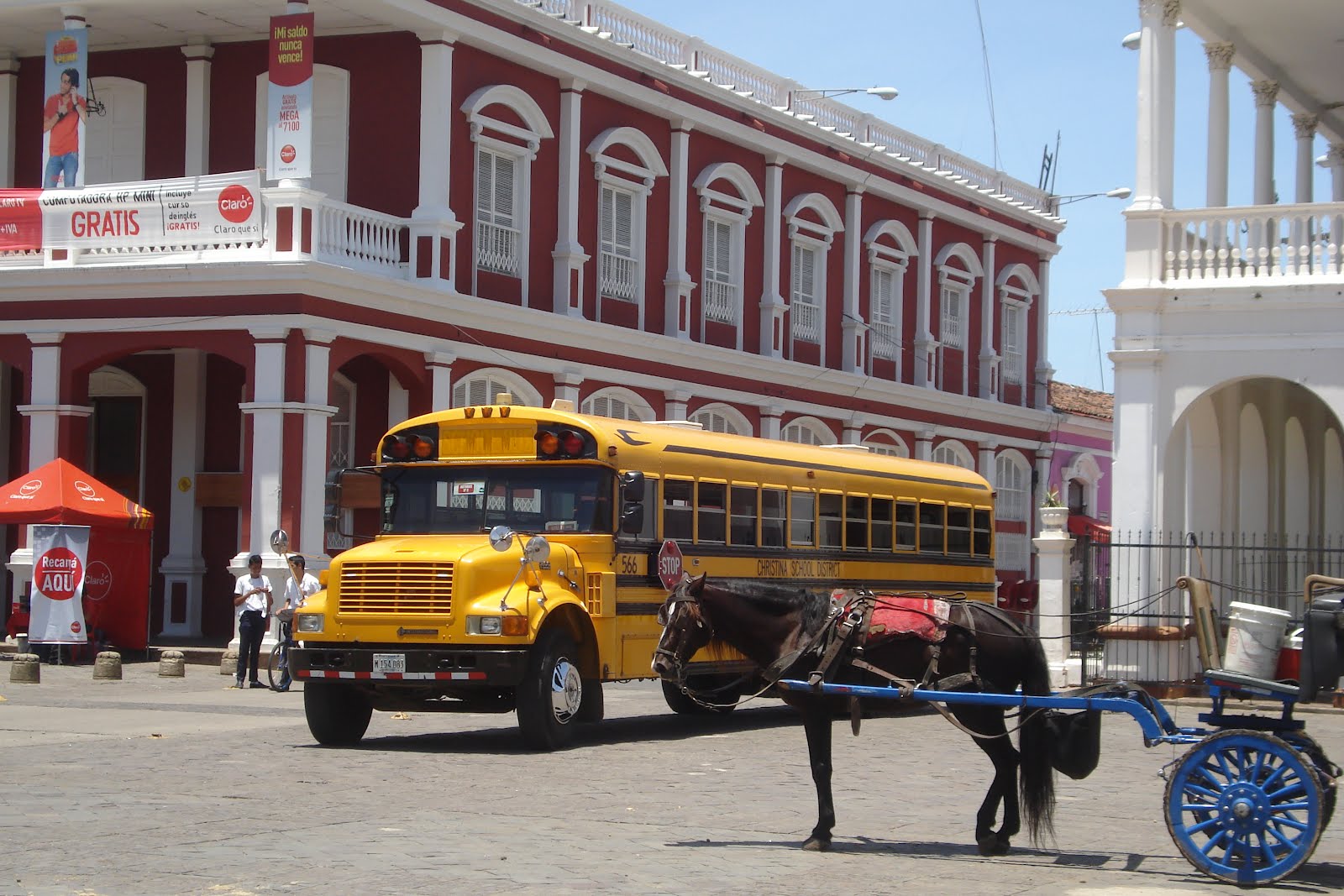
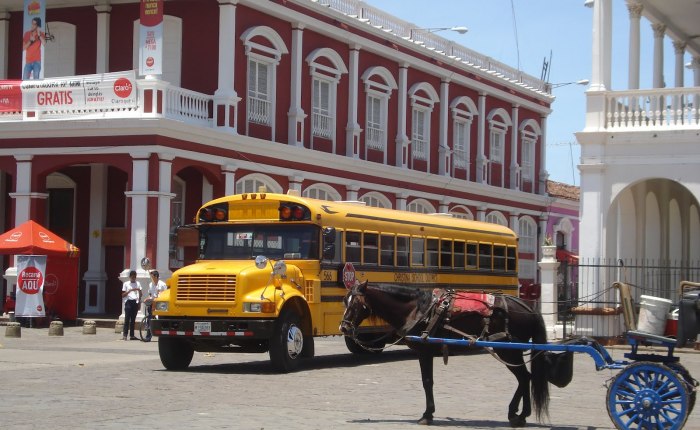
Wherever we walk there is something else more interesting to see – a primary school with smiley faces painted on the wall, intricate roofing of the delicate buildings; provocative political street art, and brightly painted old US school buses (or “chicken buses” as they are familiarly known) that we had traveled on before, almost meeting our deaths while teetering on the edge of a Guatemalan mountain pass; an exploded tire catapulting us off the road.

The horses pulling cheerful carriages giving tourists a city tour aren’t as thin as they were before and their clip-clopping on the cobbles as they pass fills my ears. Leafy trees line the sidewalks bursting full of mangoes, dropping to the floor with their weight and children pass by giggling and playing in the afternoon sun. Spiky, florescent pink fruits – picaya – are on offer from a wooden cart with two bright green budgerigars atop, plumping up their feathers.

Artists, musicians and students fill the brightly-lit plaza, now safe to cross in the evening, and the bars overflow with customers laughing and drinking long into the night.

Granada 2

Stray just a little from the main streets and you see a different side to this booming city. The poorer districts hang their washing on the lines and their humble homes are not as robust or polished as the tourist attractions which, although beautifully painted at the main entrance, are graying and in need of maintenance on the side roads.

Stray dogs roam about the streets, especially towards the poorer end, and every time we leave our hotel we adopt one for the day, faithfully following us around for a few pats on the head and a ruffling of the ears. Clearly, steel is a commodity on sale on the black market here, for almost none of the manholes are covered and if you don’t watch where you step at all times there is nothing preventing you from breaking a leg or disappearing underneath entirely.

We go into the market, just to look around. I had also promised my Nicaraguan maid that I would get her some sandals, seeing as they were so beautiful here. The tacky plastic shoes on offer were not really to my taste but I knew that they would make Janet happy and, as we move up and down the different rows of the small but well-stocked market, we also pick up some homemade hot sauce for me and a bag of cacao for drinking chocolate.

The fresh produce section is as it always is in a Latin American market – pigs’ heads stacked up on a table top, dripping with blood, huge blocks of sweating white cheese covered in flies and a small comedor filled with workmen feasting on impossibly large plates of rice and beans and an indistinguishable kind of meat. A fat lady wipes her hands on her apron, leaving a dark hand print; a mixture of animal blood and human sweat.

As we emerge from the market and set foot in the street again the rain comes quickly and without warning, turning the uneven street with gaping manholes into a river in minutes. I shriek as the plastic canopy of a shop fills and dumps cold water down the back of my dress. We fall about with laughter as we try to dodge the chasms in the street and share an umbrella blowing inside out in the extreme conditions.

Granada 3

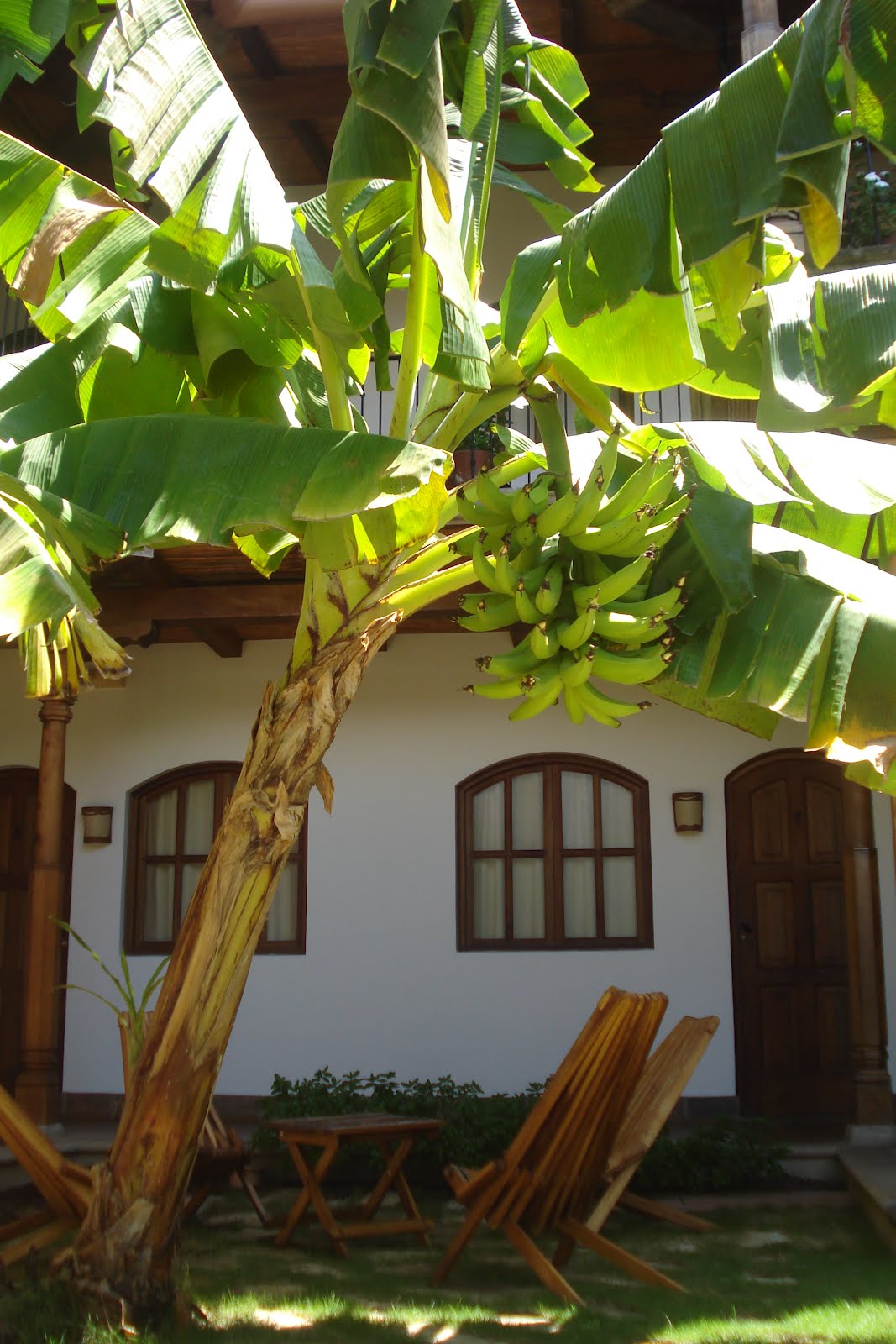
The next day dawns bright and clear and at 8 am the sun is too strong to sit in as we breakfast outside in the courtyard of our hotel, next to the swimming pool and under the shade of a banana tree. Eleven years ago, on a desperately tight budget, we had slept in converted prisons, rooms with no lock on the door and blood stains up the wall, “bathrooms” where the shower was a bucket, mattresses crawling with lice, and hens pecking outside, visible through the cracks in the wall. I smile as I’m served an enormous bowl of fruit and muesli, natural yogurt and fresh ground coffee – back then we lived on bread rolls and avocados.

Granada 4

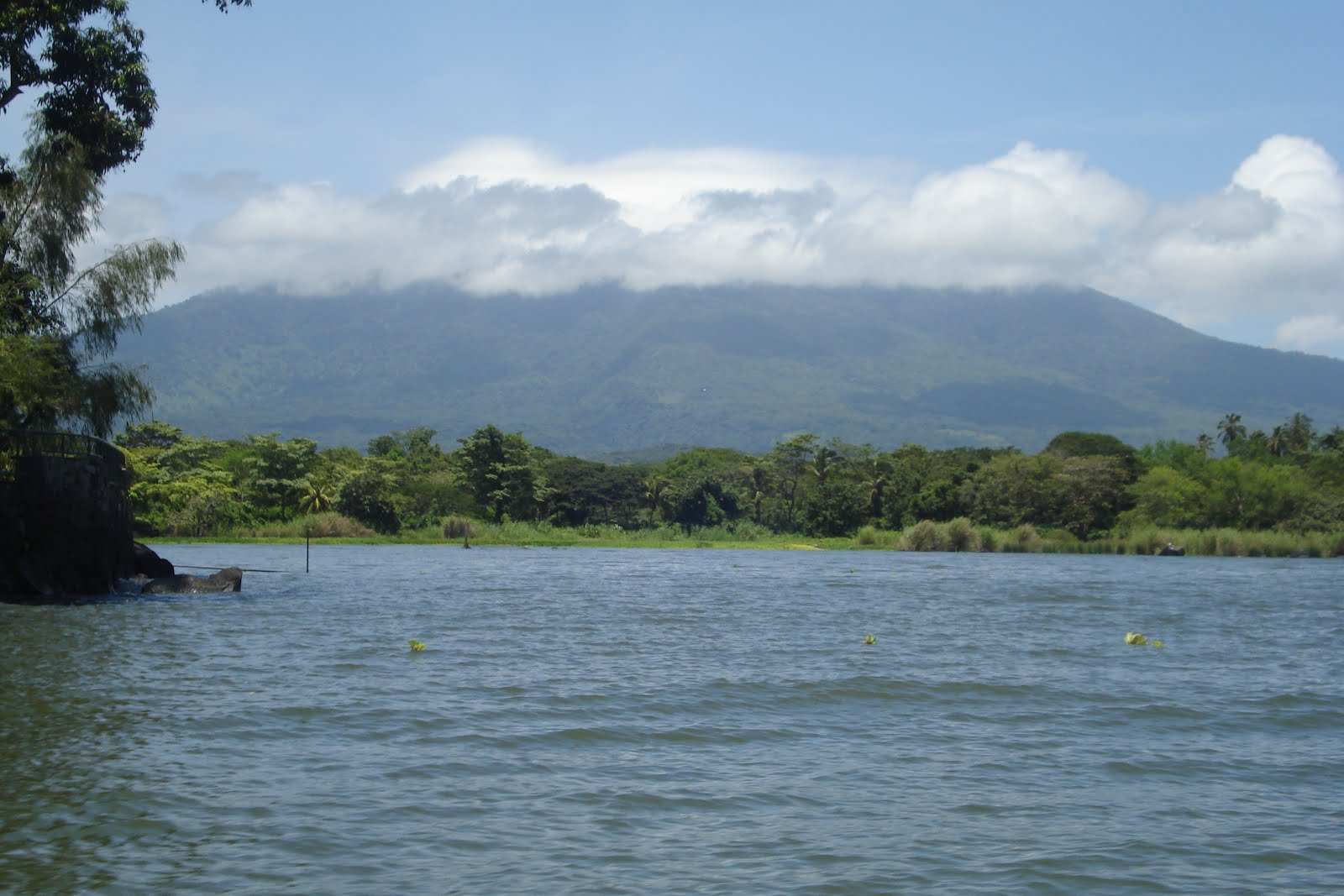
We take a boat on the lake of Nicaragua (Lago Cocibolca) to see some of the 400 or so islands sprinkled about these waters. They once belonged to the indigenous people but somehow in the march towards progress have fallen into the hands of nifty real estate firms and mostly sold off to wealthy foreigners, like the rest of Central America.

We pass one island where local fishermen and their wives still live. It is shabbier than the others and crammed full of wooden constructions that look something like homes. They smile as we pass.

Our “guide” – the skinny youth in charge of the boat – doesn’t know any pertinent facts about the lake, such as its size, or depth, or status among other fresh water lakes in the world, but he does know who is who in island real estate. He enthusiastically points to a luxurious island belonging to the owners of the main Nicaraguan brewing company, another of a Texan and one, rather kitsch-looking, reddish-pink house with stained glass windows and a miniature stone iglesia (church) owned by a couple of playos (homosexuals), he giggles as he says this.

Granada 5

I let my fingers dangle into the water and feel the sun on my face pleasant afternoon breeze. Nicaragua, it’s good to be back.

Amapala, Honduras

Amapala, Honduras

The narrow mountain highway has to make way for three cars at times, as we are sporadically over-taken by pick-ups and jeeps managed by drivers with poor judgement of distance and a tearing hurry. It’s easier to understand now why we’d been given so many varying answers as to how long it takes to get from the city to the coast; if you drive at break-neck speed and are unfazed by pulling out and overtaking the space-hogging lorries, holding your breath as you pass the hairpin bends, like thread through a needle, you will certainly arrive quicker.

DSCF0732

We take a more gentle pace for most of the route until we get more confident and match some of the Honduran drivers with a few equally reckless manoeuvres. The highway here is always a feast for the eyes, and just looking about you provides constant visual stimulation.

The slow moving truck in front, sagging beneath its heavy load and belching out black smoke, carries more than cargo. There are foot passengers standing close to each other, tightly squeezed and jiggling up and down, with the bumps in the road, wind in their hair. It looks a bit precarious and I fear for their safety as they lurch around a bend, some of them losing their balance.

Vibrant palms and thick forest with varying layers of foliage spill out into the road and tap the glass windscreen as we pass. Well paved asphalt gives way to crumbling terrain with treacherously deep chasms that are more than mere potholes; deep wells that would snap the bottom of your car if you weren’t quick enough to swerve the wheel out of harm’s way. In some parts of the road it’s like traversing the surface of the moon.

Beyond the reckless driving, the slow spluttering trucks and the neglected road surface, you have to pay attention to any other hazard that might unexpectedly cross your path; a chicken, a stray dog, a blindly roaming herd of sleepy cows, donkeys chomping at the grass verges, sheep, pigs, and farmers crossing the road with their ox and cart.

It evokes a deep contrast of feelings in the soul. In the blare and the buzz and frenetic pace of the city, you forget that deep in the lush jungles of Central America, peasants are working the land with beasts and ploughs, as they did centuries before. The simplicity, yet harshness, of the daily grind in the unforgiving steep terrain.

A young boy holds high above his head a metal prong speared with something it takes my mind a while to identify. Fried “lagartos” (lizards) are for sale with spicy jalapeno sauce. A giant yellow butterfly floats past and the sun streaks through the mist in two straight rays that cut through the undergrowth.

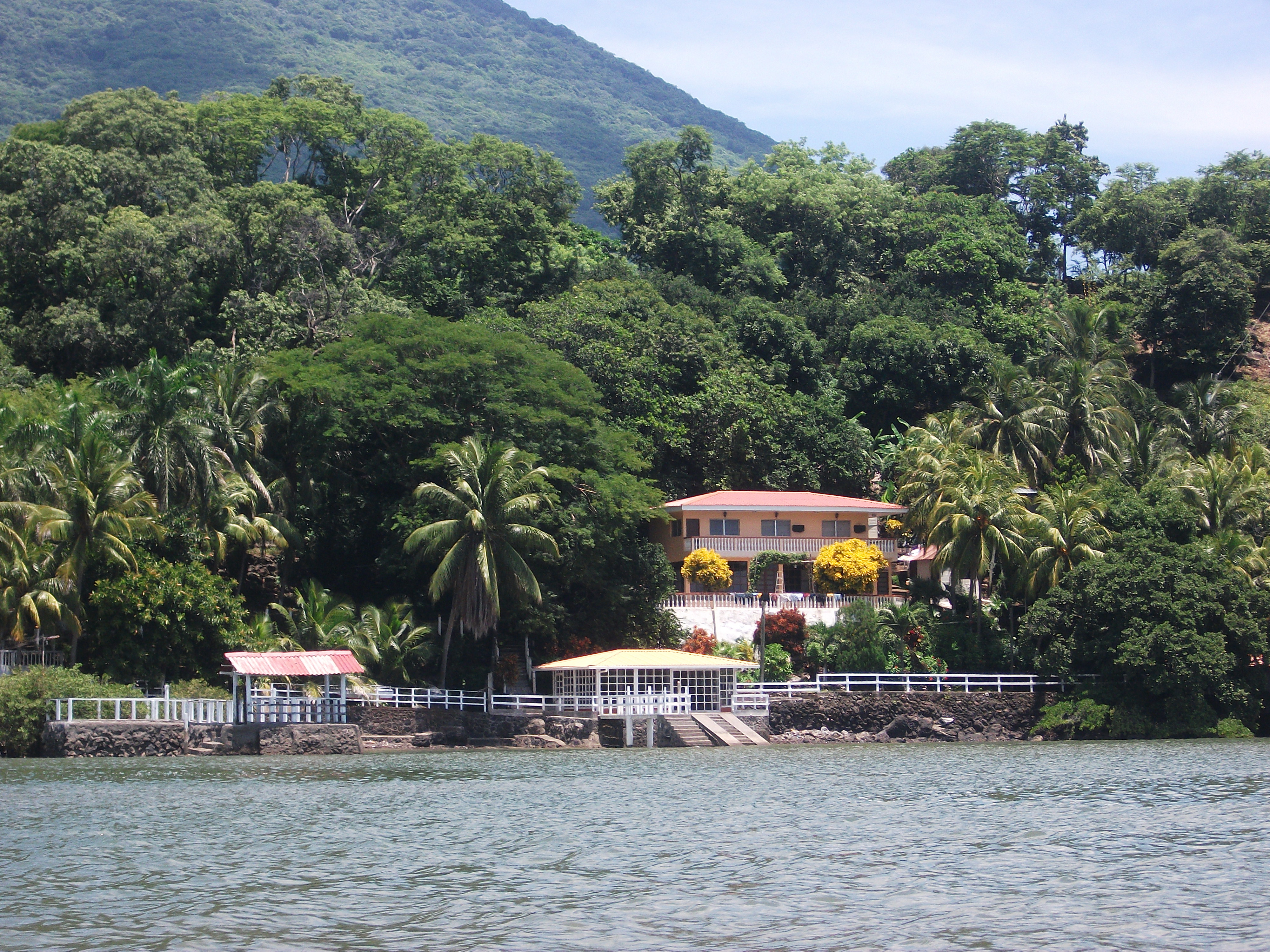
DSCF0749As we deviate from the main road towards Amapala, the mountains fold into flat lands of rice fields and corn plantains. The land is more remote here and I can’t help but notice it’s been quite a while since we’ve seen another car. We gasp as we turn the bend and the ocean glimpses in sight, dotted with green luscious islands and breath-taking dormant volcanoes, covered in dense forest, rising out of the Pacific.
Not exactly sure of where we are going or what we will find when we arrive, we roll into the little village, gateway to isla del tigre and Amapala, where all of a sudden there are clusters of people selling quesadillas, pupusas, soda and cell phone credit; some things have developed in recent years.

A stout lady with a wide nose and thick jaw, and a red tunic covering her clothing runs towards us with surprising speed for her bulk, and signals to us where we can park the car. Not having any better indication, we followed her instructions and left the rental car outside this lady’s mother’s house behind some gating, where “it would be safe” for the night, while we took the boat to the island and found lodging there.

As we stepped out of the car the heat hit us like a slap in the face as she began to explain to us the different options and prices of transport to Amapala and how things worked around here, confiding in us that, if she were in our position, she would go straight to hotel Miramar. She pauses and widens her eyes emphatically, explaining that that way we could save a few lempiras.

Anko asks if she has a cell number we can reach her on, clearly a little apprehensive at leaving the car here. She stops and stares deeply at him until her face breaks into a beaming grin and she lets out a loud cackle, explaining that she has never been allowed to purchase a mobile phone.

Apparently her husband is the jealous type and doesn’t appreciate her receiving calls from random strangers. But, she does give us her name – Delia – and inclines her head towards the old lady with the face full of wrinkles, rocking on the chair outside the house; that is her mother and she never goes anywhere. The car will be safe with them.

Placing all our trust in this jovial lady, we follow her to the dock, where two young boys scamper towards us and offer to take us in their boat. We strike up a deal, far more beneficial to them than us and the little engine chokes into life. We clamber aboard and set forth towards the island, the gentle breeze in our faces providing relief from the constant unrelenting sun. This part of the Pacific is nestled between green and fertile mountain islands and the water in places has the deep florescent color of the jungle reeds.

There are some women washing clothing by the waterside, scrubbing up and down on a steel board with bars of soap, one of them looks up and grins as we pass. Wooden shacks and barren blackened beaches provide a stark contrast to the pristine houses, rising out of sweeping palm forest, fronted by expansive windows, sun glinting on the glass, and private swimming pools at the back. This is a land of cosmic gaps between the rich and the poor, the staggering disparity at times almost absurd.

DSCF0745

We ease into the little bay docking at the orange hotel all but hidden by the imposing jungle behind. A dark skinned man with sleepy eyes and a loose ponytail stood in the doorway and with a relaxed smile shouted out “bienvenidos” as he welcomed us inside.

He explained to us the layout of the island, the prices and the (some-what) limited services of the hotel, in a painfully slowly manner that made me want to finish his sentences for him. I ask a question and think he hasn’t heard me, or hasn’t understood, as too many seconds pass before he answers.

The delayed reactions and impossibly slow speech is quite a trait of Amapala, as we discovered. The pace of life is slower; the hot sun obliging you to walk with less haste; the lack of urgency an inbuilt quality.

As we follow him up the steps to the rooms, Anko points out a dead scorpion about 8 inches long on the ground. The dense forest around the hotel seems to hum with insect life and little geckos dance across the ceilings, clicking to each other in their curious song. I close my eyes for a moment. I’m standing on a small piece of earth somewhere in the Pacific Ocean, off the mainland of Central America with barely any civilization around.

The young boy with the lazy eye and even slower speech hangs off the steering wheel, one elbow out the window as he takes us to “playa grande” where we can take a dip, get a beer and nestle our toes between the volcanic sand. Anko asks him what he does for fun and if there are many girls his age on an island such as this. After a painfully slow pause, he lets out an embarrassed laughter, “no” he laments, there are however, lots of “homosexuals”.

I swear I think this was probably the last thing I expected him to say, as we grind over the stony roads, past cheerful, bright yellow three-wheel taxis, a little stone church, a smattering of small stores and sleepy old ladies rocking in their chairs on the streets. I am trying to imagine a love parade procession here and somehow, just can’t.

He lets us out at the beach at one of the rather dilapidated “chiringitos”,(the closest thing to a restaurant here) that line the thin stretch of sand. Tin or straw roofs propped up by wooden poles, with gentle waves lapping at their base.

DSCF0760We drop down our packs at a plastic table and I jump up to dip my toes into the warm water. I look back at the collection of shaky buildings. As rustic as it may be, “playa grande” is not without its charm. If you can get past the dirty appearance of the water from the black sand and the various unidentified floating objects brushing frequently against your skin. From the water, looking back at the thick jungle jutting into the ocean, I am mesmerized. I do a half-turn towards the horizon; the looming volcano shrouded with cloud at its peak is El Salvador.

We order large plates of fried fish and camerones (shrimp), washed down with cold cerveza and lime, hot sauce and platanos, served with a plastic fork and no knife, making it impossible to eat without having to grab it with our fingers and gnaw the delicious flesh off the bones.

The sand felt good underfoot and the ever-present sun burned through the straw roof. The stress of the week and constant pressure to perform is forgotten for a while as the sounds of the jungle mix with Latin pop beats and the shrieks of giggling children bathing and frolicking in the sea.

A mangy dog lies beneath my feet, scratching its ear with the back of its paw, flicking fleas in my direction. We decide it’s time to get up and move, and walk further along the beach before launching ourselves into the water, just floating for a while, drinking in the scene.

As we get out and walk along the beach, four sting rays are lined up on the sand. Looking back at the water we realize what we’ve been floating next to without realizing. It’s time for another beer and we pull up at a chiringito packed with families. There were people eating, chatting and children playing football, the goal posts delineated with wooden sticks.

DSCF0776I’m aware of a presence behind me as I turn around to be met with a wide smile and a pair of deep brown eyes. A small boy, Carlitos, lathered in thick sun cream. We become engaged in conversation and he tells me his age (4) and that he prefers swimming to football. I tell him that I come from England, a place far away, and ask him if he knows where it is. He contemplates for a while before nodding his head rapidly and explaining that you have to take a boat to get there.

We are suddenly joined by his brothers and sisters and cousins, who form an inquisitive group around us. They start to count in English and know some of the months of the year. The little girl, appropriately named Linda, is so beautiful with her soulful eyes and earnest answers , and I wished I could take her with me, and as we left she threw her arms around me, not wanting to let me go.

As we stroll through the town on the way back to the hotel, the cobbled streets were filled with little houses, most of whose inhabitants were outside perched on their chairs, enjoying the evening breeze. Some women were preparing steaming hot tortillas with a variety of fillings in different colored pots on a large wooden table. I stopped in a pulperia to get some water, which is sold her in plastic bags, a cheaper packaging than a bottle . I am not quite sure how to hold it as it slides through my fingers, like a water balloon.

DSCF0784We hear thunder rumbling ominously in the distance and the storm clouds, jet black against the back drop of the jungle, threaten broodingly, flickering now and then with rays of lightening. We barely make it back before the storm breaks, emptying the sky with a ferocious downpour. We sit and watch as the rain soaks the earth and the violence of the storm in all its glory plays out on front of our eyes. A praying mantis crawls up the wall and the lights flicker with insects. Nature in all its glory and we are in its territory.

We survive the night and the morning dawns bright and calm and we start off the day with a “plato tipico” which definitely gives a full English breakfast a run for its money. Refried beans with platanos, egg, rice and tortillas certainly sets you up for the day.

The car has been safely protected as promised and as we pull away from the frantically waving and grinning Delia, I feel somehow in some way that I will be back here again one day.

Just a Journalist Loose in Central America

DSCF1218

It’s certainly different. I’m guessing there are few jobs in which you get to sit down with the Minister of Education in one moment, and the manager of a casino in the next. We discuss remedies for a country with an average time spent in school of five years per person and a union of teachers that aren’t sufficiently incentivized to comply with their 200 days a year in the classroom. Payment is a problem of course. The “change in government” or “military coup” (depending on your viewpoint), left the country bankrupt and you can certainly see where the priorities truly lie.

Our interview with Education takes place in a temporary office by a shopping mall, as the last tropical storm that passed through the region, Hurricane Agatha, a few weeks back, tore down the top two floors of the offices of the Ministry of Education, located in the poorest district of town. Some ministers have it easier than others.

With our suitcases in the left luggage room of our hotel, we just had time for perhaps the worst meal I’ve ever eaten (and that is saying quite a lot) in TGI Fridays in a nearby shopping mall. The over-zealous North American franchise just doesn’t quite work here, as the numerous servers with ridiculous uniforms of stockings, over-sized hats, badges and stripy shirts wonder around, attentive to just about everything except the 3 tables between them. I flashback to when “Euro Disney” hit Paris with it’s peppy, snappy, all day smile culture and fast food outlets; the concept of which was totally lost upon the sullen French.

From there we make our way to the Majestic Casino. Having just spent ten minutes in the back of the stiflingly hot car, I feel like my face is literally melting, as we negotiate our way inside. Entering this establishment is quite a feat, and we have to pass through the security guards with AK47s and knock surreptitiously on the bolted doors to pass. The interview is conducted in a haze of smoke.

It’s a mixture of sensations frankly and I haven’t had enough time to adapt. Sometimes I just feel overwhelmingly guilty. As I look around the grotesquely over-furnished offices and listen submissively to the same vapid rhetoric from insipid politicians about eradicating poverty and sharing the wealth.

DSCF1328

I spent such a frustrating morning today trying to schedule interviews with largely corrupt or targeted businessmen that frankly prefer to keep a low profile. Out of more than 100 phone calls I successfully confirmed 2 appointments. “Fijase que sigue almorzando” (he’s still at lunch); coo the receptionists with a rhythmical Latin lilt that makes it impossible to stay angry at them.

Still, lunches that last three hours, phone calls that are directly cut off, being passed to the wrong person, or worse, given the wrong address, gets a little tiring after a while. It’s also a curious thing in Honduras that no one has a proper address. Not once have I been given a name, number and street. It’s always “3 blocks west of the white river, between the blue house and the petrol station” or “next to the shopping mall above the Central bank”. I don’t think anyone uses the actual mail here. You would have to obtain a very big envelope, with the description “left at the brick building and before the police station, after the banana seller, Tegucigalpa, Honduras”.

The truth is it’s a hard slog if you try to go it alone here. In countries like these you are nothing without who you know and if there is no one to open the door for you then it will be slammed in your face. In their tightly knit communities everything moves by contacts and there is nothing like a nod of the head from the appropriate minister to let you in.

The escalating drug problem north of the border in Mexico is only exacerbating the outlook for the future here. Moving the filth from one region to another, re-routing the drug runs through Central America. How else can you explain the announcement of the closure of the international airport of Tegucigalpa for one week? (In fact it was only 24 hours in the end). Apparent holes in the runway sounded about as plausible as British Rail’s “leaves on the line” and I think that few people were fooled. The enormous jets that landed in the middle of the night loaded with cash told a different story.

You certainly get to mix with some of the most disgustingly privileged people on earth, as they slump back in their leather sofas, stacked high with plush silk cushions, bleating on about all the triumphs realized under their leadership. Feather-filled pillows, an old-style library, various elaborate artefacts, a Honduran flag and a panoramic view of Tegucigalpa.

Apparently there’s a popular saying that Columbus said to the people of Honduras “no hagan nada hasta que vuelva” (don’t do anything until I get back) and that’s exactly what they’ve done. But with over 65% below the poverty line, natural disasters, out-of-control epidemics of diseases and a wealthy class of European descent that isn’t willing to share the power, it’s so hard to see a resolution to this problem.

I admit I wrestle with my own prejudices. I am automatically opposed to the people we see, without hearing what they have to say and it makes it hard to find a thread of common ground between this largely nepotistic, right-wing, undeservedly advantaged society.

Still, it’s a constant learning curve, as stressful as it can be. We sat down with one of the most influential businessman in Honduras, who inclined towards us and explained the truth (or at least his version of it) behind Zelaya’s abrupt removal from power in the middle of the night at gun point almost exactly a year ago.

It’s depressing, but you find out quickly that there is very little difference between the right and the left. Whichever party allows the business men to exploit the people, pay the least taxes possible and attract foreign investment without internal political PR disasters; the better. If you know whose pocket to grease, then it really is fairly indifferent which undeserving puppet is put in power.

The best part of my day is kicking off my heels, letting down my hair, talking to the people in the street and walking to the supermarket. A man with no shirt and a carton a strawberries balanced above his head asks me if I want to buy. I smile and say not this time but ask him if he knows of a pharmacy nearby. Not only does he explain, but he leaves his cargo and walks me to the end of the street, making sure I don’t get lost. His life has been so different from mine, but in this brief exchange I feel a common bond. Because at the end of the day, as ugly as it can get, people are people wherever you go.

No Shirt, No shoes, No shit, No problem

ce78bfece1514ba889edd189dae52df6

Out of the corner of my eye I could see the two men under the tree. Horizontal and relaxed, shaded from the penetrating midday heat, one chewing on a long blade of dry, brown grass, the other pulling on a cigarette.

“That’s total evidence of this tropical climate, that tan you got right there baby – you look like syrup,” the first one drawled, removing the straw from his mouth.

His friend sat up and a large, lazy grin spread across his face, wrinkling his thick, jet-black, skin. He pushed his dreadlocks out of his eyes, cooing, “I like the way you walk baby – why don’t you come over here?”

I received their comments with a mixture of mild irritation and amusement. The men here are forward. The beer and cuba libres flow freely and the Caribbean sunshine goes to the head like an intoxicating drug.

Strikingly set apart from its Latin neighbors, Belize, home to a diverse mix of people and cultures, often feels like several different countries at once. The Creoles (descendants of the African slaves and British pirates who first settled here) speak the official language of English with musical lilt, Caribbean flavor, and poetic license.

Spanish is the first language in the north and some towns in the west, where the Maya and mestizos (persons of mixed European and Central American Indian ancestry) concentrate. Garfunas (of South American Indian and African descent) dominate the south, and small pockets of Europeans, Chinese, East Indians and North Americans also make up Belize’s improbable population, adding to its unique charm and character.

Creaking and bumping into Belize City by bus is truly a feast for the eyes. Chaotic and bustling with activity, loud voices can be heard selling oranges, pineapples, cigarettes, jewelry, clothing, and, as I wouldn’t put past some shady Belizeans, their own grandmothers.

Whether they’re trying to sell something, help you out, or scam you, the colorful language and facial expressions used by the friendly Belizean people always bring a smile to the face. “Honey, you could die three times and still come back,” responded the boat hand when I asked if my ticket to Caye Caulker was good for the return journey.

The cayes are numerous islands that bask in the shallow warm waters of eastern Belize. The essence is on relaxation, with street signs on the pedestrian Caulker reading ‘Go slow’, ‘Hesitate… you are here’ and, my personal favorite, ‘Betta no litta’.

The sound of reggae beats and smells of charcoal grills fill the air. Beach huts and ramshackle hotels dot the length and breadth of the caye (about four miles long and only 600 meters at its widest point) and brightly colored hammocks swing from palm trees.

Five star luxury it isn’t. Caye Caulker is a poor man’s Caribbean. Shrubs and roots pepper the white sand, and there are few places to swim or sunbathe because of mangroves and lack of space that is not covered by grass or buildings.

Yet despite this, Caulker maintains a certain amount of charm and character. Serving mainly as a jumping off point for the coral reefs, it’s largely uncrowded during the day. Those who remain on the caye can be found swinging in hammocks or diving off the jetty into the deep waters at the ‘split’ (so-called because of Hurricane Hattie that literally split the island in two in 1961).

Over the years, Caulker has suffered the wrath of many powerful and dangerous hurricanes. This is evident in structural damage to flimsy beach side hotels. Many palm trees lie broken or bent along the shoreline, and Caulker’s most popular swimming spot, ‘the split’, is testament to the devastation a fiercely whirling hurricane can wield.

The islanders who live here are familiar with the tropical storms that ravage their home every year. Living in fear of a hurricane large enough to raise their houses to the ground means that their houses are little more than a few slats of wood nailed together, as if the less ostentatiously they build, the less they will have to rebuild when the time comes.

Children run around with dirty noses and huge smiles. The older ones launch into triple back flips off the jetty, throwing themselves into the air, daring each other to jump higher or further, or splash louder. Theirs is a lifestyle handed down by parents who have witnessed how fragile life can be. No one here takes themselves – or anyone else – too seriously. There’s a sign hanging outside the Sand Box bar which reads:

“No shirt,

No shoes,

No shit,

No problem.”

On the third night of my stay, I went to the Sandbox and unexpectedly witnessed the capabilities of a tropical storm firsthand. I watched as the ink-blue sky was suddenly illuminated by a fork of lightning, followed by a rolling boom of thunder. I saw the black silhouettes of the palm trees swaying against the backdrop of the night and felt the power of the wind.

The rain poured furiously. Sheets of water fell from the sky, blowing sideways into the bar, as it was caught by a heavy gust of wind, drenching those inside within seconds. The bar tender ran towards the door and pulled down the wooden hatches, winking at me.

As crash followed crash, and the intensity of the rain continued, I asked a local near me about Hurricane Keith – the last major hurricane to rock the island. He chuckled as he described the noise of the wind and the ferocity of the rain.

“I heard that wind and it was like he saying ‘I got a whole lot more where that came from!’” He stopped suddenly and looked sombre, his face taking on a deadly serious composure. Gesturing towards the hatches, which were rocking fiercely in the wind he said, “this sound just like Keith.”

My horrified face must have been a picture, because he took one look and let out a loud, belly laugh. “Honey this bar wouldn’t be here no more if this was another Keith!”

The next day, wandering lazily along the caye, the sun was out and the puddles had drained away. Food stands and tour operators were open, and tourists and locals were swimming in the clear waters again.

Deciding it was time to go out on the reef, I was bombarded with offers. Huge, brightly-colored banners plastered with underwater pictures are displayed outside every store, and it is hard to see much difference in the services offered.

My concern was that I would end up on an overcrowded party boat and have to compete for space and equipment. I began to examine some of the flyers I had picked up before noticing a small painted sign reading ‘JUNI’ in white letters on the side of a beach hut.

A man of about 60 was gently rocking on a chair on the balcony, looking down at me with an expression of faint amusement.

“Are you Juni?” I asked. He nodded calmly, fixing me with an intense gaze. At last he said: “If you’re looking to go out on the reef, I have something very special going on out there.”

I liked his soft brown eyes and the coral cross he wore around his neck. I liked his calm manner and knowing expression. He was the type of person whose presence made you feel safe and I decided to go to the reef with him.

Although nurse sharks enjoy a placid reputation and are rarely provoked, I was nervous as we sailed into Shark Ray Alley and I could make out the shape of one swimming beneath our boat, the magnifying quality of the water making her appear huge. Juni had timed our arrival just as the powerboats, heaving with sunburned bodies, were leaving.

He threw out the anchor into the green waters below and, in his unhurried manner, turned to face us: “I am going to tell you a story. You will never have heard anything like this before.”

As he stood on the edge of the boat, he looked like a mythical character, serious and earnest. “Almost ten years ago I was in my boat when I came across a female nurse shark that had been speared by a fisherman.” He spoke softly, as if confiding a great secret.

“She was weak and bleeding. So I brought her some food and stayed with her for a while. The next day I went back and fed her and stayed some more time with her. I went back every day and, after three weeks, she was up. She was better. She swam with me all day.”

He paused and looked round at each of us, as if to make sure we were listening, and then continued. “One day I noticed that she was getting fat. I called her gordita,” he smiled: “I did not realize that she was pregnant.”

He went on to tell us of how she had two babies and, although one of them died, the other had three babies of her own. For ten years now Juni had returned almost daily to swim with his sharks.

As beautifully as he told the story, I could’t help but feel cynical until we spent a couple of hours with his shark family. On that day, just three of them came, the grandmother and two of the young sharks. As soon as Juni splashed into the water, they were by his side. They followed him closely, and we followed Juni.

Every movement he made, they moved with him. When he rolled over and when he swam, they did too, playing with him as he turned them over and stroked their undersides.

Juni beckoned to me underneath the water and I swam close to him. He nudged one of the baby sharks toward me and I patted her back. Her skin was scaly, like the rough surface of a cat’s tongue. Juni turned her over and I held her in my arms for a moment and stroked her soft belly.

Swimming with these sharks gave me an insight into how intelligent and peaceful they are. Each beautiful, graceful movement they made and their acceptance of us was touching.

I was unnerved only when they speedily changed direction, making a sudden U-turn, and three meters of shark swam towards me. Their two barbels (thin, fleshy, whisker-like organs on the lower jaw that sense touch and taste) hanging low, like teeth, provoking an irrational fear of sharks instilled in me from watching Jaws many years ago.

But there was no malice in these sharks, just an inquisitive playfulness. When Juni led us back to the boat he gave the sharks one last pat on their heads, and a morsel of fish each before they swam off away from the reef and out of sight.

Watching the sharks go, I realized that I had never felt such a close affinity with wild animals before, and it was elating. A smile appeared on my face that refused to fade.

As we sailed back to the caye with the warm air blowing in our faces, I noticed the name painted on the side of Juni’s boat – Trinity. I asked him why he had chosen this name. He smiled and said “My boat, my ocean, my sharks… my trinity.”

Juni was a man who needed nothing more in his life. The wooden slatted beach hut, lack of family, even a home that was rapidly being built upon and blighted in the name of tourism, mattered little to him. Out on the blue horizon are his family. On his boat is his home.

Caulker was evacuated just two days after I left. The strong winds of Hurricane Chantal, with gusts of up to 100 km per hour stopped just short of being a classified a true hurricane, whose winds much reach over 119 km. I thought of Juni, and the words he had spoken through a wide smile: “I like hurricanes, they control the gringo population.”